It has been a while since we first introduced Project O.A.S.I.S., and behind the scenes, the engineering work has never stopped. Today, we want to share important hardware design upgrades integrated into the final production units.
Based on rigorous field testing, community feedback, and structural engineering optimization, we have significantly improved how the radio reception architecture, protective layers, and I/O access are integrated into the workstation:
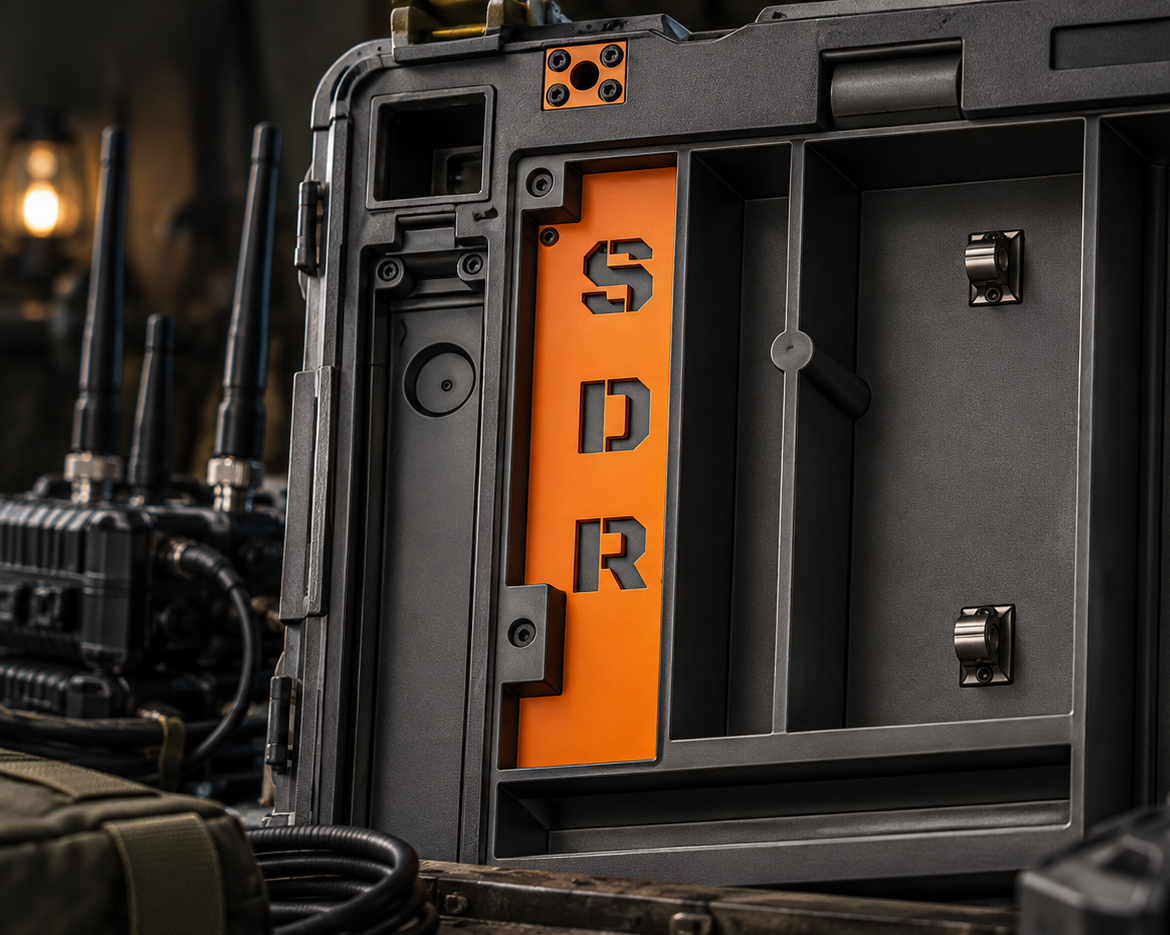
Hardware Upgrades: Integrated SDR RTL V4, Antenna Feed & Expanded I/O Access
Internal SDR Integration & Dedicated Power: The SDR RTL V4 module is no longer an external USB dongle. It is now fully integrated inside the internal compartment with its own dedicated, clean power supply line.
100% User-Accessible & Future-Proof: While cleanly integrated internally, the SDR module remains 100% user-accessible. It is not permanently sealed or hard-soldered—if a newer SDR version or specialized receiver module comes out in the future, you can easily swap it out yourself, keeping your workstation fully modular.
Integrated Antenna Feed: The antenna mount is completely integrated into the chassis architecture, featuring an RF antenna port output identical in design and standard to the Meshcore node port.
Uncompromised I/O & USB Port Ergonomics
Lewy górny róg: Jeden szybki zewnętrzny port USB 3.0 na głównym panelu pozostaje dedykowany dla szybkiej pamięci masowej, transferu danych lub sprzętu zewnętrznego.
Dostęp z prawej strony: Dodatkowy port USB 2.0 po prawej stronie laptopa pozostaje bezpośrednio dostępny bez konieczności podnoszenia lub wyjmowania komputera Getac S410 z jego gniazda.
Full Getac I/O Expansion: If you need full native port access (Serial/RS232, LAN, HDMI, etc.), the Getac S410 can be lifted out of the case while remaining fully connected to all internal modules and power systems.
100% Mechanical Structural Frame & Thermal Strain-Relief
All primary panel inserts, module mounts, structural frames, and lid retention profiles are 100% mechanically fastened—eliminating reliance on structural adhesives that degrade, dry out, or fail under heat or heavy vibration. For internal power leads and USB connections, dedicated mechanical retention channels are reinforced with thermal strain-relief potting to guarantee vibration-proof connection integrity during off-road transport.
Engineering Victory: Nora Dell CR HEMP Shielding Integration
The single greatest engineering challenge was mounting the Nora Dell CR HEMP protection layer in a way that remains permanently secure without creating structural weak points or seam gaps. By developing custom mechanical retention profiles, we successfully secured this specialized shielding layer while preserving full attenuation and physical durability.
Enhanced Durability & Weather Resistance
Eliminating external dongles means fewer moving parts, zero risk of snapping the module when closing the lid, and maximum resilience against harsh weather, vibration, and extreme temperature fluctuations.
Every backed unit directly fuels this production run and helps bring this fully independent, air-gapped tactical workstation to life.
Thank you for being part of this journey!
Best regards,
Adam
Creator of Project O.A.S.I.S.
0 komentarzy