PROJECT O.A.S.I.S. – Offline Advanced System for Information and Survival
End of dependence on external infrastructure.

Meet your new offline intelligence friend: a fully functional, independent tactical hardware and autonomous command node enclosed in a rugged protective case, built to solve the problem of modern electronics failing when the power grid or telecommunications network goes down. It features instant access to the entire Wikipedia offline database and thousands of curated survival guides for any situation, proving that this is not just a gadget, but a secure, local AI system designed to keep you operational when everything else fails.
The grid goes down. OASIS stays up.
How did it start?
Initially, I built this system strictly for my own personal use. I was looking for hardware that would give me 100% operational independence, but the market offered nothing that met my rigorous standards. Everything changed the moment I showcased the first working prototype on social media.
The response was unprecedented. Thousands of messages, likes, and a massive wave of inquiries from people worldwide made one thing clear: the demand for this kind of independent solution is massive. This project is no longer just my personal vision—the world actively needs this type of hardware, and I am doing everything to deliver it.
Most modern electronics become useless the moment the power grid or telecommunications network fails. Project O.A.S.I.S. was built to solve this exact problem. This is not a gadget. It is fully functional, independent tactical hardware—an autonomous command and communication node, enclosed in a rugged protective case.

Evolution and a hard reset
The overwhelming community feedback forced me to raise the bar. The sheer scale of interest made me revise the entire concept. I spent hundreds of additional hours completely redesigning and perfecting the system from the absolute ground up. The hard feedback from future users revealed the massive spectrum of applications for O.A.S.I.S.—from professional crisis management during natural disasters (hurricanes, floods) to a fundamental sense of security for people wanting to protect themselves and their loved ones in uncertain times.
What really matters?
WHAT MATTERS IS THAT YOU ARE INVESTING IN YOUR OWN SECURITY AND SELF-RELIANCE.
I sincerely hope you will never have to deploy O.A.S.I.S. in the actual crisis scenario it was built for. But having it ready, knowing what it can do, and having that capability within reach gives you complete peace of mind.
This isn’t just another piece of tech. It’s your Plan B when the grid goes down.

Simulated deployment context. The background is an AI-generated visualization representing field use cases; the OASIS unit shown is the actual physical prototype.True EMP Shielding: Built for the First Commercial Offline Workstation
Everything you place inside the case is fully protected against electromagnetic pulses—your phone, flash drives, SSDs, and digital archives. Your memories and critical data will survive when everything else is wiped out.
Project O.A.S.I.S. is engineered around a fully enclosed, continuous conductive Faraday barrier designed to protect critical electronics against high-altitude electromagnetic pulses (HEMP), high-power microwave (HPM) threats, and severe solar storms (CME).
When sealed and stowed, internal drive bays, hardware modules, power subsystems, and offline archives remain completely isolated from catastrophic transient voltages.
Certified Shielding Material: Shieldex® Nora Dell CR
https://www.shieldex.de/wp-content/uploads/2021/05/F-VTT-Datasheet-Shieldex-Nora-Dell-CR-V12.pdf
The core isolation layer utilizes Shieldex® Nora Dell CR—an industrial/military-grade metallized Ripstop fabric engineered in Germany by Statex:
- Multi-Layer Metal Matrix: Electro-plated with Silver, Copper, and Nickel, sealed under a protective Urethane CR coating.
- Ultra-Low Surface Resistivity: Measured at <0.009 Ω/sq, providing the extreme electrical conductivity required for instant E1/E2/E3 EMP transient attenuation.
- Structural Durability: Ripstop nylon base with high tensile strength (430 N warp) and high abrasion resistance.
Laboratory Testing & Compliance Standards
The conductive lining performance is backed by formal laboratory testing under strict military and industry standards: IEEE 299/2006 and MIL-STD-188-125 (the gold-standard military baseline for high-altitude EMP protection of ground-based C4I facilities).
- Tested Spectrum: 0.2 GHz to 40 GHz.
- Attenuation Peak: Up to 82 dB to 100+ dB attenuation across sub-GHz and microwave bands.
- Real-World Impact: An attenuation level of 80 dB to 100 dB reduces incoming electromagnetic wave power by 99.999999% to 99.99999999%, effectively blocking destructive field strength from penetrating the closed chassis.
Passive Isolation Architecture
When the workstation lid is latched shut, this continuous conductive layer creates a seamless, fully grounded inner enclosure around all internal components. Your hardware, offline system backups, and core communications gear stay protected and ready for operation when grid-level disruptions occur.

TIER-ONE DISASTER RECOVERY SOLUTIONS:
CORE RECOVERY FUNCTIONALITY
A compact, EMP-hardened, offline system designed for immediate local recovery.
- LOCAL COMMUNITY KNOWLEDGE HUB: Contains a local-cached, decentralized wiki database of survival and recovery protocols (Survival Guides, Food Preparation, Medical, Construction).

HYBRID COMMUNICATION & SIGNAL INTELLIGENCE: Integrated with twin long-range radios, a portable MESH node, and an advanced Software Defined Radio (SDR) for wide-spectrum scanning, signal interception, and frequency monitoring of critical communications. Establishing immediate local, ad-hoc text and data links.

EMERGENCY DATA LOGISTICS: Secure, air-gapped storage with redundant backup for critical local records, maps, and coordinates.

AUTONOMOUS OPERATIONAL READINESS: Powers a Getac rugged laptop, and charges small gear; solar or multi-fuel generator charging compatible.

Simulated deployment context. The background is an AI-generated visualization representing field use cases; the OASIS unit shown is the actual physical prototype.
Bridging the Gap: The Decentralized Future of Emergency Communication
Imagine a world where every rescue station, emergency response unit, and local municipality is equipped with an OASIS unit, creating a resilient, autonomous communication network that functions completely independently of cellular infrastructure or a stable power grid. While traditional satellite internet is vulnerable without ground stations, OASIS provides guaranteed connectivity and critical information access when it matters most, empowering communities and first responders to stay operational and in touch, even in the total absence of conventional infrastructure.

Strategic Civilian Resilience (OASIS Home Base)
Stationary grid-down scenario or prolonged home emergency management where local infrastructure, power grids, and internet access are entirely severed.
Core Functions:
- Acts as a central, self-contained information and communication hub.
- Continuously monitors local RF spectrum activity using the passive SDR receiver to track emergency broadcasts or local signals.
- Maintains instant local access to complete offline medical, survival, and technical databases without relying on cloud services.
- Power & Logistics: Plugged into the optional dual-battery configuration with continuous power management, utilizing hot-swappable battery packs to maintain infinite runtime indefinitely during stationary operations.
- Mesh & Comms: The built-in MeshCore node in the cover establishes a fixed regional secure communication relay, linking family members or local team members equipped with compatible trackers.

TACTICAL COMM & MESH CORE ARCHITECTURE
- Integrated Mesh Node: A fully embedded MeshCore node built directly into the top cover, providing decentralized, off-grid communication that connects seamlessly with any compatible mesh tracker in the field.
- Dual Field Radios (Baofeng PMR / FRS): Two dedicated handheld radios included for immediate local voice communication, deployable directly into the field.
- Triple-Radio Capability: The internal SDR operates as a powerful, passive third radio—dedicated strictly to real-time, wideband receive-only monitoring and spectrum analysis.
NO HAM LICENSE NEEDED.
Complete local autonomy: voice, data mesh, and passive RF intelligence in a single integrated unit.

O.A.S.I.S. HUB: Zero Compromises. Zero Shortcuts.
When I set out to build the O.A.S.I.S. HUB, one core principle guided me from the initial sketch to the final screw: no compromises. I didn’t look for ways to cut costs, I didn’t cheap out on materials, and I didn’t count the hours spent perfecting every single component. The result is a system built strictly for maximum durability and total field reliability.
Yes, it is heavy. Depending on the final hardware configuration, it weighs between 11 kg and 14 kg (24.3 lbs to 30.9 lbs). And that weight is a badge of honor.
That mass exists for a reason. It is the direct result of using ultra-rugged, heavy-duty internal inserts designed with a manufacturing precision of 0.05 mm (approx. 0.002 inches) to survive extreme operational environments. I refused to use thin plastics or cheap shortcuts at any stage. That weight represents complete power autonomy, cooling, accessories and armor-grade protection for your mission-critical gear and data logistics.
This is not a mass-market consumer product pushed off an automated assembly line without real quality control. Hand-crafting, assembling, and precisely fitting a single unit takes approximately 3 full working days. Every system is built individually with obsessive attention to detail and thoroughly tested before it leaves the bench.
The O.A.S.I.S. HUB isn’t built to be ultralight or to cut corners. It’s built to work when everything else fails.

POWER BEAST: Unlimited Off-Grid Runtime
When power grids fail, static battery capacity isn’t enough. Project O.A.S.I.S. is engineered for continuous, uninterrupted field operations.
- Dual-Battery Architecture: One of the very few tactical builds on the market featuring a dedicated dual-battery module system for maximum energy density and redundancy.
- Hot-Swappable Power System: Swap depleted power units on the fly without shutting down the system or interrupting critical local processes.
- Scalable Independence: Expand your operational window effortlessly. Add as many secondary battery packs as your mission requires—extending runtime from hours to days of continuous off-grid use.
- Field-Ready Reliability: Zero downtime during power swaps keeps your radio spectrum scanning, local AI, and critical reference bases active when you need them most.
Maximum power flexibility. Zero reliance on the grid.

No IT tech skills needed
Clear, Step-by-Step Instructions & Video Tutorials: You don’t need an IT degree or technical background to operate the system. Every unit comes with straightforward, illustrated manuals and detailed video guides walking you through every aspect of configuration and daily use.
Designed for Anyone: The entire software and hardware architecture has been built from the ground up so that an absolute beginner can handle deployment, power management, and offline databases without external help when it matters most.

The man behind this project
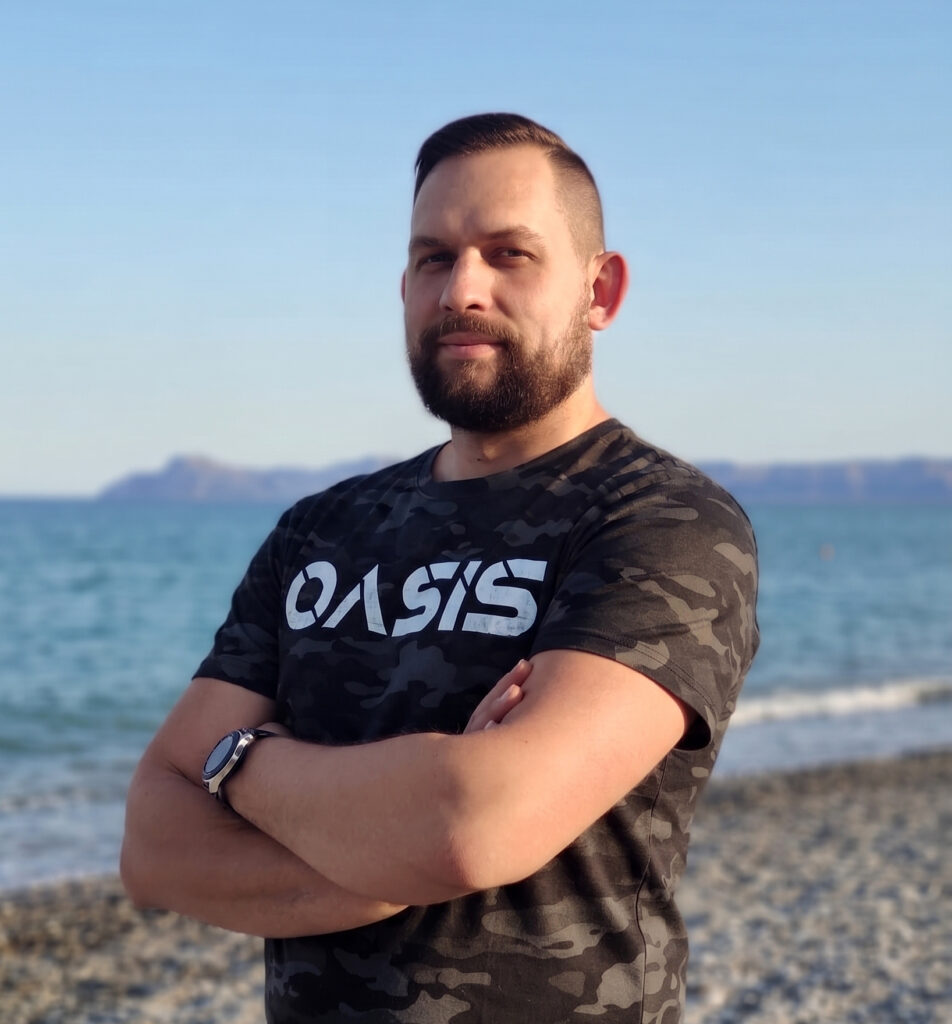
Adam Sienkiewicz [Sienek1986] – Szef Projektu i Konstruktor IT, były wojskowy i jedyny twórca Project O.A.S.I.S.
Nie zaprojektowałem tego systemu za korporacyjnym biurkiem ani nie zbudowałem go na automatycznej linii montażowej. Każda pojedyncza jednostka jest przeze mnie zaprojektowana, stworzona w druku 3D i ręcznie złożona. Moje podejście nie uznaje kompromisów: zero dróg na skróty, zero tanich plastików z wtryskarek i zero zależności od kruchej infrastruktury zewnętrznej. Wnętrze każdej walizki opiera się na precyzyjnie zaprojektowanych, drukowanych w 3D wkładkach, które stabilizują i chronią elektronikę nawet w najcięższych warunkach.
Poza O.A.S.I.S. specjalizuję się w niestandardowych, wzmocnionych konstrukcyjnie urządzeniach taktycznych. Moje portfolio obejmuje projektowanie wysokobezpiecznych sejfów izolacji akustycznej (OASIS BlackBox) oraz budowanych na zamówienie taktycznych stacji roboczych, wdrożonych na potrzeby prywatnych agencji detektywistycznych.
Zacząłem budować O.A.S.I.S., ponieważ potrzebowałem bezwzględnej niezależności operacyjnej, której rynek komercyjny po prostu nie był w stanie zapewnić – gwarancji łączności i zasilania tam, gdzie kończy się cywilizacja. Gdy pierwszy prototyp spotkał się z ogromnym odzewem ze strony ludzi na całym świecie, stało się jasne, że to nie tylko prywatne narzędzie, ale kluczowy zasób dla każdego, kto ceni prawdziwą samowystarczalność.
Jestem osobiście odpowiedzialny za cały proces: od wstępnych koncepcji inżynieryjnych, przez fizyczny druk i montaż elektroniki, aż po rygorystyczne testy i produkcję.